I’m Tara, a socialist writer mom who lives in North Carolina. I’m trying to balance community-building with my quiet way of life while also spending less time online, yet here we both are. Hello!
Thank you to everyone who’s followed my writing on this website! I have returned from my period of retreat and am now posting essays on Substack. This is a monthly paid subscription service, though I will occasionally share content for those with unpaid subscriptions. My first two posts on the site are free of charge, and I would love for you to read them!
The first is an introduction to my new online home (which will strongly resemble what you’ve seen here on Stuff I Love).
The second is a review of the 1987 Diane Keaton film BABY BOOM, which perfects a rom com formula that any Hallmark movie fan is guaranteed to love.
I hope that you will continue to follow my work and join me in celebrating what remains beautiful and bright in these very dark times. You can also follow me on Bluesky at rareoats.bsky.social for daily doses of funny/lighthearted/pretty content.
One of the most helpful mantras my therapist ever uttered was “rest is productive.”
I’m feeling a bit overwhelmed lately, mostly in a good way. I’m writing a book! It’s an anthology of essays about a central topic that brings me much joy. I’m making as much time for it as possible, while also immersing myself in the muse that’s inspiring this big project. Pardon my vagueness – I’d like to avoid being the writer who rambles on and on about the piece instead of just writing it. But also, I am actually writing the piece! I’m currently sixteen essays in. My goal is to complete a full draft manuscript by Thanksgiving, at which point I can dive into rewrites.
I’ve never worked this long and this diligently on a piece of writing without sharing any of it with anyone. I’m used to writing individual essays for online posts – plugging away for a few days, polishing as I go along, getting my husband read and edit, and then giving it one more work-through before sharing it with y’all. It’s a pretty swift process. But writing a book is completely different. I’ve never had to be this patient with the process of getting to a draft that’s ready for others to read. I’m really proud of myself for putting in all this work without immediate rewards.
And again I feel overwhelmed! I’m a full-time working mom who does customer service on her feet all day, five days per week. I’m trying to be a good parent and partner to the most important people in my world, while also maintaining a social life, getting enough exercise, eating right, and doing the necessary research to make this book really good. It’s a joyful yet exhausting life.
So where does that leave this website? Since I started writing these “Stuff I Love” posts at the beginning of this year, this is the first week when I’ve felt just completely blank. It isn’t that I love life less than usual. On the contrary, being locked into this other project feels wonderful. But I don’t care to talk about it in any detail yet. And since this little website is mainly intended for self-expression and fun, I just don’t feel compelled to force an essay when I’m not feeling inspired to write one. I don’t need to manufacture a distraction from my bigger project, just for the sake of meeting a self-imposed deadline.
So I’m going to take a break from this website, at least until I complete the first draft of my manuscript. I’ll still be writing, just not anything that I can share quite yet. But when I’m ready, I think many of you will love it! I will keep you posted.
From ages sixteen to twenty I worked part-time as a page in my suburban hometown’s public library. This job entailed many activities – shelving books, retrieving periodicals, helping patrons use the microfilm reader, sneaking cigarettes in the breakroom, and gossiping with my coworkers. I well remember the mildly scandalous occasion when another page named Cindy went on a couple dates with security guard Kevin. Kevin was all of five years older than Cindy, which didn’t seem like such a big deal in itself. The real kicker was, to put it bluntly, that 22 year old Cindy had “virgin” written all over her face. And Kevin, while being a friendly, good-natured, and inoffensive guy, seemed like he’d been around the block way more than a few times. She was an odd girl with an unfortunate poodle haircut, who dressed in bland pastel polo shirts and mom jeans. Her manner of speaking was like that Alyson Hannigan character from American Pie who starts every sentence with, “This one time, at band camp…” And just like that character, Cindy seemed to have no awareness that she was at all weird or awkward. She seemed equal parts innocent and oblivious.
When your special interest is “band camp”
Kevin, on the other hand, seemed like your average socially adept, moderately attractive, horny young dude. To me, this romantic combination spelled trouble for Cindy. I recall some of my coworkers and I screaming, “Her?!” when we heard the news. And I also distinctly remember one of my fellow teenage employees — a kid named Malcolm from Detroit — saying in a very firm tone, “It’s just like my mom says, ain’t nobody’s business if they do.” And he just kept saying, “Ain’t nobody’s business if they do!” over and over again, louder and louder, until the rest of us dropped the subject.
At the time, I couldn’t understand why Malcolm didn’t wanna jump in on our busybody speculation. But now I’m quite impressed with his wisdom. Malcolm and his mom were 100% correct. I’m glad I’ve learned to be less judgemental. In fact, I love to mind my own business.
Of course, learning to mind my own business took a lot of unlearning. This can be especially difficult for us recovering Catholic types who regularly give ourselves a hard time for not being good or virtuous enough. In fact, when I deal with people who are noticeably judgemental (to the point of it getting in my nerves), I take a sort of grim satisfaction in knowing they probably torture themselves at least as much as they make life difficult for others. I know that condition from my lifelong experience with a mean voice inside my head who I call “Cheryl.”
Heeding the advice of writer Julia Cameron (who some of you may know from the book The Artist’s Way), I’ve learned to identify and isolate the mean inner voice in my head that constantly judges me. For decades, this voice has kept me from doing things I really want to do, so I may actively pursue all the things she thinks I should do. And just as Cameron advises, I have given this mean inner voice a name and personality. In my case, this obnoxious, judgmental bitch is a highly skilled waitress named Cheryl. She is perfect at her job, a master of efficiency and multitasking. She groans loudly whenever I make a mistake. She also finds all of my delicate feelings very embarrassing and cringes whenever I express my emotions. The only way I can impress her is by following the precise set of arbitrary rules she has developed as a means of doing her job so well. According to Cheryl, artistic pursuits are for spoiled rich kids and poor losers. To be a real adult is to toil hard on your feet all day, with a smile plastered on your face. And lord help you if she ever catches you crying in the walk-in cooler when you could be rolling silverware in napkins of bussing tables instead.
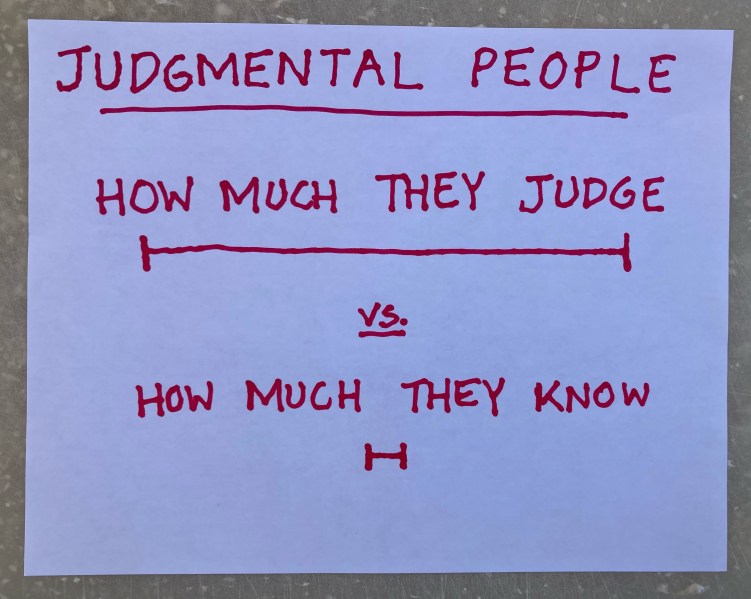
Clearly I have had some traumatic experiences working in food service! Anyway, the truth about this Cheryl inside my head is that she is a dumb bitch. Sure, she’s really great at this one thing, but what does she know about anything else? That’s the glaringly obvious thing about people who don’t mind their own business. They think they know it all, but their judgment will forever impede their curiosity. Never do they wonder, “Why is this person doing this thing I don’t understand?” Instead, the thing they don’t understand becomes “bad.” And that’s how you end up assuming that the harmless security guard at work is some depraved perv for going out with the weird girl who talks about band camp too much. For all I know, maybe like the girl from American Pie, Cindy was kind of a perv herself!
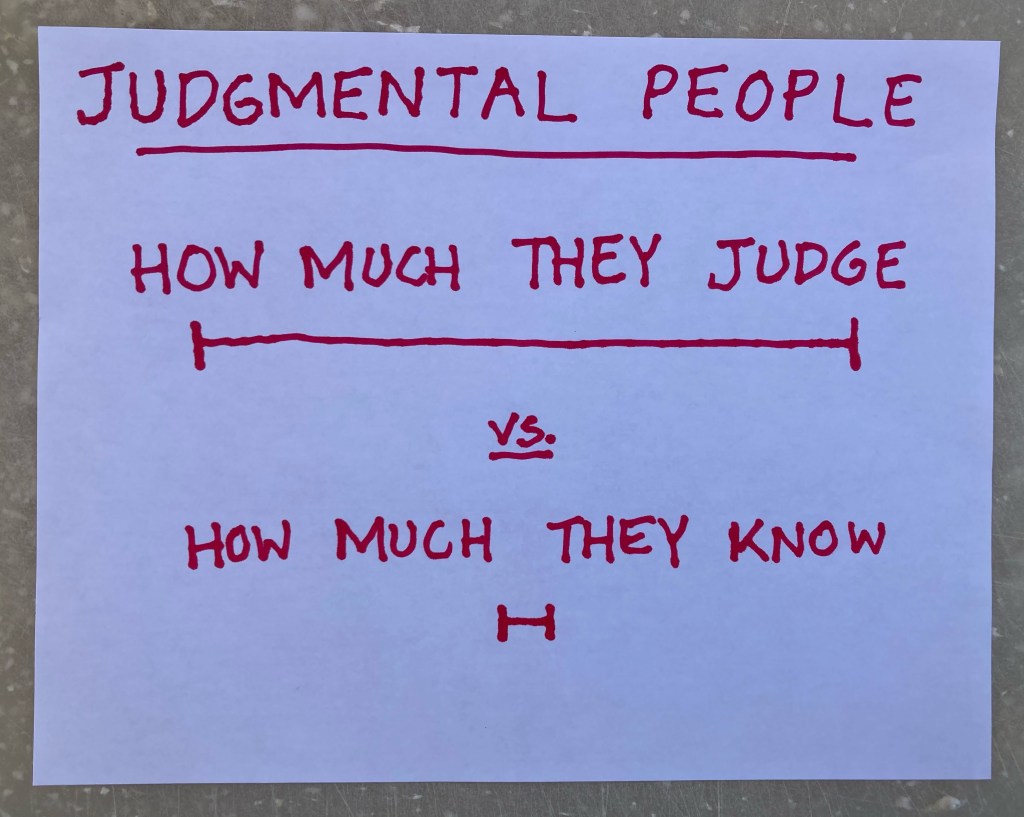
Made a helpful, little chart.
Life is a lot more fun now that I’ve gotten the hang of replacing judgment with curiosity. When I hear Cheryl say “eww” in response to something someone says or does that strikes me as odd (but doesn’t hurt me or anyone else), I generally default to “well, what the hell do I know” and move on. There’s so much I don’t know that I’d like to understand better, and yet so much more that I don’t care to interrogate at all. All of Cheryl’s criticism, negativity, and labeling come from a fear-based need to control. And controlling is so much work! I’ve become a big fan of surrender. If it doesn’t concern me, I can just let it be. What a relief!
Something about Simone Biles openly discussing her therapy journey as she collects Olympic medals has further invigorated my belief that matriarchy is rising.
Occasionally I’ll see a fellow leftist share a meme about how therapy is “bad” because capitalism is actually the source of all our problems, and mental healthcare is just an individualized band-aid solution to massive systemic oppression. Every time I see one of these memes, I let out a big, heavy sigh and chalk up another victory for the FBI agent who came up with this brilliant little scheme to keep the left as mentally ill as possible. What an incredibly foolish thing, to discourage our peers from seeking necessary healthcare that is already so difficult to access. For every ten people who simply cannot afford therapy, I would bet there’s at least one person who can afford it but won’t go. And the reason they won’t go is a stigma that I consider extremely patriarchal in nature. The mindset around trauma and mental health is that if you can’t stuff your feelings deep inside of you and white knuckle your way through daily life, despite the gnawing sadness and pain throbbing within, then you just need to stuff it harder. Leftists might try to frame their critique of therapy as some deep statement about capitalism, but I suspect the aversion just comes back to patriarchy, which says dealing with trauma and hard feelings is icky girly shit.
So yeah, I’m pretty excited to see the greatest gymnast of all time — truly one of the greatest athletes ever — take on her own mental health setbacks in a very public way, then come back to win some more gold medals. It not only uplifts her journey, it also helps us see how much psychological strength it takes to be an Olympic gymnast, to keep your balance and stick the landing. It heightens our awareness that all of these women are incredible. It was lovely to see her and her competitors cheering and congratulating each other throughout the competition. The image of her and fellow US gymnast Jordan Chiles bowing to Brazil’s Rebeca Andrade as she collected her gold medal in floor exercises makes me want to cry.
In a similar vein, I was also very moved by Team USA’s stunning come-from-behind victory in the women’s rugby sevens bronze medal competition. It was incredible watching these buff warrior women tackle each other again and again, with barely any protective gear. And when Team USA scored their shocking, last-minute conversion goal, many of the girls keeled over in tears. Because how could you not fall over crying in such a situation? As someone who took a long time to learn that tears are a totally natural response to all kinds of intense feelings that need not be hidden, it’s wonderful seeing buff warrior women bawling on an international stage. If the toughest women athletes in the world can cry openly and effusively, then I don’t think we have to call it icky girly shit anymore. I believe the patriarchal mindset around facing intense, overwhelming feelings might be dying. And we’re replacing it with something much better.
The US Women’s Rugby Team celebrates their bronze medal victory.
Nothing puts me in a more mindful headspace than climate change.
Last month I saw an Onion headline that said “Report: Every Place On Earth Has Wrong Amount Of Water.” Here in my little corner of the Carolina Piedmont, we’ve been struggling with drought. For weeks we saw barely any rain while also experiencing sweltering, near triple-digit temps. Yet somehow it was also miserably humid? The air becomes your enemy in that scenario. It feels filthy, just saturated with that mugginess that comes from all plant life emitting their last gasps of moisture in the sizzling heat. The grass turned so scrawny and brown. I found it quite deflating.
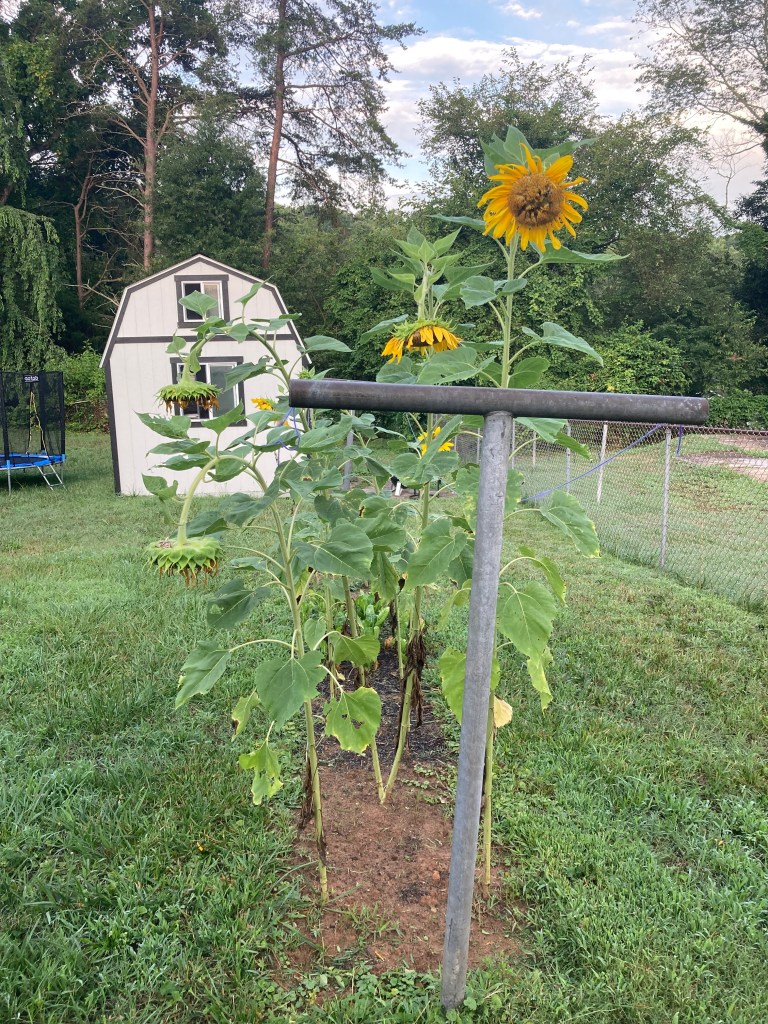
Naturally this was the year I decided to start gardening. I don’t regret putting in the yard work, though the weather wound up throwing us a curveball. When I was tearing up the lawn in early April, creating a bed between two retired clothesline posts, I wasn’t thinking how this pesky red clay soil would feel when parched. The soil itself posed enough of a challenge. I quickly learned why so many people use raised beds instead of growing anything in the ground here. Still I planted my seeds, bulbs, and a few starters, then waited to see what would happen. May brought many delightful sprouts. And then in June, just when my chard and sunflowers were beginning their abundance, it stopped raining. So frustrating.
The upside to this is that tending my humble garden in these conditions has kept me very present. It’s provided a useful lesson in figuring out when to water the stuff in the ground vs the stuff in pots – how heavily and how often. It’s taken a lot of trial, error, and observation. My potted basil plant has vacillated between bulbous and withered so many times that I’ve lost count. All I know is that nothing makes it so happy as rainwater. The stuff from the spigot has performed crucial life support, but the plants thrive best when fed by clouds.
And so it went for June and most of July — me just trying to keep my small crop alive. I’m now pleased to report that we turned a corner and are finally getting rain again! Last week the heat broke (or at least descended to the upper 80s) as clouds rolled in. We’ve had several heavy showers and much drizzle since. From where I’m sitting on my bed, I can see the tree trunk next door has broken out in gorgeous, pistachio green patches of lichens, a sign of a much healthier humidity that I love to savor. Now I get to be present for the glorious regreening.
It’s hard knowing there’s so much drought and flood in our future, isn’t it? The unpredictability of climate change can foster a lot of fear. And yet there’s some solace in knowing the future remains unwritten. I’m gradually learning that being present for whatever’s happening right now really is the key to surviving and thriving in difficult times — whether that means gently responding to the needs of my withered plants or taking a moment to inhale the glorious perfume of rain after a long dry spell. There’s grief, love, and beauty in all of it.
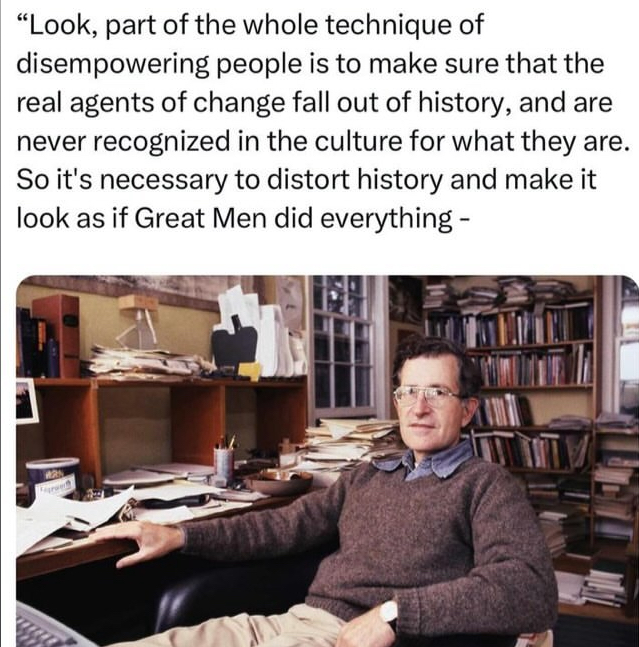
I don’t admire any presidents, though a few have done some good. Instead of giving them credit for their occasional beneficence, I think of all the unnamed, unknown, everyday people who struggled against oppressive systems and institutions until they built enough power to push a president’s hand. Instead of praising our political leaders for abolishing slavery or establishing the New Deal, I save my gratitude for abolitionists and labor unions. Presidents are very important figureheads to a society so fixated upon celebrity and individualism. It’s comforting to believe that Great Men of History have ushered in revolutionary change. We like the idea of good guy saviors — perhaps especially when we fear we’ll once again be ruled by a bad guy villain.
The problem with putting a lot of faith in Great Men of History is that it becomes very difficult to criticize the rest of their record, like the war crimes. Or the slave owning. Or the sexual assault accusations. A coworker recently asked me if college students who were protesting Biden’s policy on Gaza would also say FDR was a terrible president because he oversaw internment camps for Japanese immigrants. I said, “Hell yeah! I mean, I think most presidents are pretty terrible.” She was so upset she had to walk away.
This is why I don’t often disparage Great Men of History to their fans. I really don’t like hurting other people’s feelings. Because even though I have no reverence for the GMoH, you know who I do admire and respect? Regular, everyday people. The ones who actually change history, when they’re not too busy just trying to get by and caring for the people they love. That means I’m talking about you! And not just because you’re reading my essay. Even if you’re hate-reading this, I probably respect you more than FDR. You know why? Because you haven’t overseen internment camps. It’s similar to how I like my Republican-voting coworkers better than I like Obama, because none of them embraced a wreckless, deadly campaign of drone warfare in the Middle East. Would they have done the same if they were ever in his position? That doesn’t matter to me because I know they never will be. They’re regular people, just like me. And sometimes they help me find merchandise in back stock, or hold the door when I’m pushing a cart out to the sales floor. Those relationships mean way more to me than how I feel about any world leader.
So I don’t wanna bicker with you about your favorite presidents. Because I like to not hurt your feelings. Not insulting everyday people is one of my guiding principles in life. I do hope that someday we can release our collective attachment to Great Men of History and see where the actual paradigm-shifting goodness comes from —- regular people like us working together. That’s how all progressive, historic change happens. We don’t need those freaks in D.C. to do anything but our bidding.
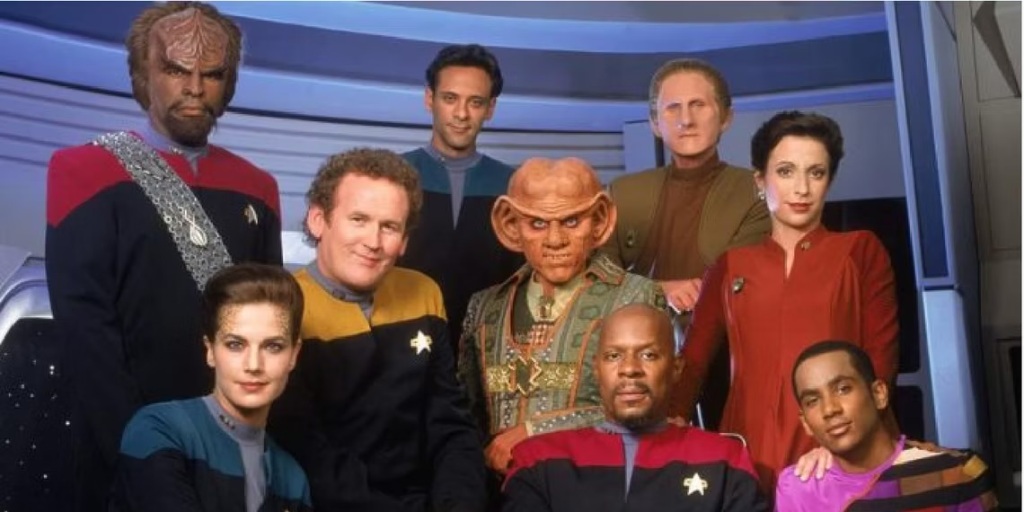
I recently started rewatching Star Trek: Deep Space Nine for the first time in many years. What a fantastic show, so engaging from the start. The series looks at what happens when the Federation assists the recently liberated Bajoran people in operating a space station that was once a work camp run by brutal Cardassian occupiers. I always felt, even back in the day when I watched new episodes of DS9, that the Bajorans were heavily Palestinian-coded. In the context of Israel’s current genocide in Gaza, this show presents a very compelling story of how communities recover from systematic murder and exploitation, including all the political turmoil that follows.
It’s a gripping and sometimes disturbing show, and yet I cannot help the fact that it often lulls me to sleep. It’s the Star Trek-ness of it that gets me. I have a long history of falling into the deepest slumber while watching these programs. It started when I was a kid who hated both Star Trek and naps. It always seemed to happen on a Sunday afternoon. One of my older brothers would get a hold of the TV dials and say, “Ooh, Star Trek’s on!” And I’d say, “Ew, I hate that show. It’s boring!” And then they’d say, “There’s nothing else on, just dumb sports,” which was usually true. And before I knew it, there would be Spock and Captain Kirk on our screen, with all those strange bee-boop spaceship sounds in the background. I would try to get into the story, try to care about whatever green woman Kirk was romancing in that episode. But I just couldn’t. And then the bee-boop sounds would start to get me. Suddenly I’d feel my eyelids getting heavy and then I’d drift away into the most placid snooze…until I was inevitably awoken by the siren sound of that insane woman humming over the end credits music. My eyes would pop open, I’d see the Desilu Productions credit on the screen, and then I’d be filled with a groggy rage. Tricked into yet another nap by the dullest TV show in the world!
I’ve maintained a pretty bad attitude about naps over the years, but my opinions about Star Trek have changed drastically. I started watching The Next Generation reruns as a teen and got hooked. That’s when I learned you didn’t need to be a science nerd to love Star Trek. You can be a budding socialist who dreams of a better future where exploration replaces militarism, money doesn’t exist, machines create all the food and other necessities you need, and women in authority are called “sir.” I began watching reruns every night. Eventually I got into Deep Space Nine, particularly after TNG’s Worf joined the series in season 3. When both series started getting released on DVD in the early 2000s, my boyfriend would bring home the box sets as soon as they popped up at the used record/video store where he worked. Being able to binge an entire season at my leisure felt like such a dream.
Of course now I can stream all of the series in their entirety, which is truly a beautiful thing. But something about catching a random episode on TV always felt like such a joy. When my husband and I moved to Chattanooga in 2010 and he’d just started his first job post-grad school, one of my great low-budget delights was watching the 11pm nightly TNG rerun that came in on our digital antenna. One evening my husband noted, “Tara, you never make it through the episode. You just fall asleep on the couch every night.” But what a comforting way to drift off! Those soothing white noise background sounds from the bridge, coupled with Patrick Stewart’s gorgeous accent and stately cadence, felt like a security blanket. Moving to a new town 600 miles away from everything I knew was really scary! I didn’t know what this isolated Appalachian city had in store for me. But I knew exactly what would happen aboard the Starship Enterprise, because I’d already seen every episode. It didn’t matter if I fell asleep.
Drifting off to DS9 is a different experience, because I haven’t watched in a long time and don’t often remember what happens at the end of each episode. I do know that its harsher storyline becomes quite complicated as the series progresses. TNG was a series of many standalone stories in which justice usually prevailed. DS9 takes a darker, more nuanced view of its various humanoid species, and even the Federation itself. I don’t want to miss what happens in any story, so I find myself scrolling back to the last scene I can recall before the bee-boop sounds of the space station lulled me to sleep. Like I’ll wake up to some intense, climax-building music and think, “Oh my god, did one of the main characters just die?!” And then I have to skip back to the crazy twist that makes it all make sense. Honestly this sort of show shouldn’t be soothing in the least. Part of it’s the bee-boops. Part of it’s that I’m just getting sleepier as I age. And maybe part of it is that in 2024, the DS9 deep trauma vibes feel way more real than TNG’s utopian atmosphere. Perhaps there’s some comfort in that familiarity.
The cast from Star Trek: Deep Space Nine (Paramount Television)
I always remember that today is the birthday of a Swedish guy I dated 24 years ago. I was absolutely bananas about this guy. We got together in early 2000 during his study abroad college year. I’d just broken up with my previous boyfriend, this really grumpy, passive aggressive dude who’d get upset with me over weird stuff while insisting he wasn’t, all while hunching his shoulders, crossing his arms, and shooting death glares at my face. The Swede was so chill by comparison. We lived together in a student co-op and hung out in the same group of beer-drinkers and stoners who’d gather in the common room most evenings. I had a big crush on him for weeks before I’d even thought about dumping Grumpy. But something about the rise of the new millennia got me in an “out with the old” mood. I broke up with Grumpy, dropped out of college (which I hated), and started dating the Swede all within the same month.
Knowing the Swede would be returning to his Nordic homeland in June, we made the most of our brief time together. I couldn’t help falling in love. He was so handsome and funny, just had this incredibly deadpan way of speaking. When he walked in the room, everything else went into soft focus. Like I finally understood that effect they use in TV and movies. I was smitten hard, and I didn’t hide how I felt. He was far more reserved. I remember him telling me one time, “The thing about Americans is that they’re always saying things are ‘awesome!’ or ‘great!’ They use a lot of exclamation marks. But things aren’t really great or awesome all the time. It feels exaggerated.” That was his personality, very cool and subdued. And here I was, a shameless walking exclamation mark, especially where he was concerned.
When he started getting sad about leaving me, I told him it was all gonna be fine because I was going to visit him that summer. My father worked for an airline, and so long as I pretended to still be in school, I could get dirt cheap tickets abroad. When the Swede departed in early June, going to visit him became my everything. Frankly, I didn’t have much else going on at the time. I’d been working at a campus deli for a few months, where I got paid cash under the table to “manage” the place (which basically meant being in charge of me and one other employee during the slow summer closing shifts). I remember preparing corned beef, reaching into buckets of bloodied brine to pull out raw meat and thinking, “Well this is gross, but I’m doing it for the Swede!” When we reunited in Stockholm that August, I was just so happy to see him that I didn’t give much thought to what would follow my eventual return to the states. The fact that we barely talked about it should have been a strong indicator of what was to come.
We spent some time in Stockholm where he had a dorm room. And we spent some time in Uppsala, at his family home. We rode out to the countryside and stayed in their cabin, then took a little motor boat trip island-hopping in the Baltic sea. I’d been to Europe a couple times previously but being there with natives felt like such a novel and eye-opening experience. I learned a lot about what I now consider “the good life” — dining on fresh, organic fruits and veggies, wonderful seafood, delicious cheeses. I ate melon with prosciutto for the first time. Stockholm felt like this magical, ancient city scattered across many islands. I also saw things like Ikea furniture and large, open beer halls that are so commonplace in America now but were still pretty exotic to me back then. I was already in awe of the Nordic social programs the Swede had boasted about when he was forced to deal with shoddy US systems — things like universal healthcare, paid parental leave, mandatory paid vacations, and free college tuition. But there was also this aesthetic experience I found so new and exciting. I was as enamored with Sweden as I was with the Swede.
When I got back to the states and reacclimated to my post-vacation life, I really didn’t have anything going on. While my friends got ready to go back to school, I looked for a different dead end job and wondered what I should do with myself. So naturally, I figured I should save up some money and move to Sweden. Unfortunately the Swede did not agree with this plan. That was a very rough and very expensive phone call. “I’m already forgetting how to speak English,” he pleaded. And that was beside the fact that such an arrangement would just put way too much pressure on him. I knew everything he said was rational and fair. But all I could hear was the voice in my head saying, “He doesn’t love you as much as you love him.” I did not take his refusal well.
I haven’t spoken to the Swede since then, though we did keep up via email over the next few years. I eventually apologized for freaking out on him during that awful breakup call. He was gracious, but I stayed embarrassed about it for years. And it wasn’t just my bawling on an international call that made me blush for my younger self. It was everything about our relationship — how insecure I must have been to want to move abroad for some guy I’d dated for a few months, like the world’s most desperate walking exclamation mark. Or the fact that it took me so long to get over him. For a couple years, I’d have this recurring nightmare that he moved back to the student co-op and I’d be so excited to see him again. And then he would just completely ignore me. Every time I woke up from that dream, it felt like my heart had been smashed all over again.
A couple weeks ago, I dreamt that I saw the Swede at a co-op reunion. I was just so tickled to see him and catch up, because I never thought we’d have the opportunity. We started talking about our spouses and our kids, but then he paused just to say, “Oh and by the way, I just have to let you know that I’m not interested in getting back together.”
In the dream, I rolled my eyes, laughed and said, “That’s okay. I’m not 23 anymore!” But I woke up mad. My first thought was, “Why would he say that to me?” And then once consciousness settled in, the question became, “Why is my mind saying this to me?”
Well friends, I’ve done a lot of journaling and meditating about it and finally came to this conclusion — I need to love and honor that year 2000 version of me who bravely quit what she didn’t want (school, a grumpy boyfriend, etc.) and chased her passions all the way to Stockholm. Who would I be without her? It’s okay that I didn’t have much going on at the time, because I was only starting to give some thought to what I did want in life. It turns out I’m fine with “dead end jobs” because I love not caring much about the thing that makes me money. Many, many years later, I would learn that the only jobs I do care about are writing and raising a child. Had I stayed in school and with the grumpy guy, would I be better off than I am now? I doubt it. I’m also so grateful for the chaotic young woman I was then for taking me to a place where I could see the sort of great life one can have in a more socialist society. It’s no wonder I wanted to expatriate.
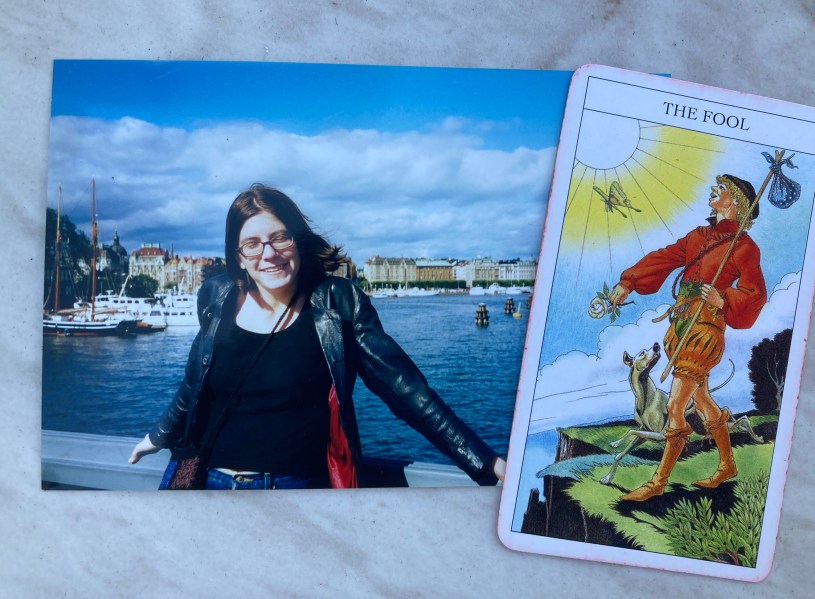
When I consider all that happened 24 years ago and in the years that followed, I’m so struck by the fact that I got together with my husband (my best friend, my fellow exclamation mark) just six years later. Six years isn’t such a very long time, but it felt like three lifetimes in my twenties. In any case, I regret nothing of the choices I made along that path. Perhaps I was a fool at times, but I prefer to compare myself to the one represented in the tarot – eyes on the sky, feet nearing the cliff’s edge, vulnerable yet oddly confident.
The author in Stockholm, August 2000. The Fool, from the Sharman-Caselli Tarot.
As of today, I am two years alcohol-free. Hooray!! When I first quit drinking, I had no idea I’d continue abstaining this long. I was just trying to give my body a break from sleep issues or the slightest sensation of a hangover. I had no idea that sobriety would lead to me getting very real with myself in ways that were not always comfortable or easy. And yet I never wanted to go back. I just didn’t feel like using booze to cope anymore.
Once I no longer needed alcohol to numb discomfort, I was better able to discern what I truly enjoyed about drinking. Turns out, I adore the ritual of enjoying a fun, festive, unsweetened beverage. So I’ve been playing a lot with mocktails, non-alcoholic beers, and other sorts of N/A concoctions these past couple years. Here are some of my favorites:
My “Dry” Dirty Martini
I strongly believe there should be more savory beverages. I’ve always loved salty more than sweet, but for a long time I thought my only savory beverage option was a Bloody Mary. Then I learned the joys of olive brine mixed with clear liquor and became a bit OBSESSED. Dirty martinis were an at-home staple when I was in my 30s. I hardly ever bothered with shaking/straining – that’s too much work, plus I liked a little ice melting in the bottom of my glass (it’s what a drunk Pam Beesley called “second drink” in the “Dundies” episode of The Office). My go-to recipe included either vodka or gin, dry vermouth, olive brine drizzle, and a couple olives on the rocks. Cheap olives worked fine, because the booze buzz made up for low quality.
When I gave up drinking, I missed the flavor of this salty concoction and came up with my own N/A version. NOTE: when you subtract the booze buzz, flavor becomes everything:
1 shot Seedlip Garden 108 — a clear, non-alcoholic spirit with herbal notes that reminds me of gin
Lemon juice spritz, to replace the vermouth
Generous drizzle of anchovy-stuffed olive brine. The anchovy is key, because that umami kick gives it a depth of flavor that other brine just doesn’t have
Garnished with two anchovy-stuffed olives
Served on the rocks. Long live second drink!
My N/A Manhattan
I still miss the aroma and flavor of bourbon – or as I affectionately call it, “boy band.” My husband and I became big boy band enthusiasts shortly after we moved to the south in 2010. A shot of Bulleit on the rocks with a sprig of mint or basil was, to me, a perfect summer beverage.
There are some very respectable N/A whiskeys on the market, but to my knowledge no one has yet to replicate the complex flavor of bourbon. Nevertheless, I enjoy making this version of a Manhattan. It doesn’t taste precisely like the real thing, but it has a light fruitiness and bite that keep it interesting:
1 shot Ritual Whiskey Alternative, which has a peppery heat that feels like actual whiskey burn
½ shot Blutul Rose Vermouth (non-alcoholic), which has a nice grapefruit kick
Splash of bitters (which are technically alcoholic, but not enough for me to feel)
Maraschino cherry syrup drizzle
Garnished with maraschino cherries
On the rocks
Non-Alcoholic Beers
If you’re a beer enthusiast who’s interested in abstaining, the good news is that there are many delicious N/A brews on the market. But much like real beer, there’s a lot of crap, too. I divide the options into three categories:
Worthless, malty swill Tastes like beer, sorta. But at what cost? The worst one I’ve encountered so far is Ceria Grainwave, which is like a sickeningly sweet version of Blue Moon Belgian White. I trashed nearly an entire six-pack.
Tastes almost exactly like the okay beer it’s imitating If you’re alright with Heineken, Guinness, or Corona, you’ll be just fine with the non-alcoholic versions of those beers. These are not anything I would necessarily seek out, but they’re a fine choice at any restaurant that has limited N/A beer options.
Truly tasty! My inner beer snob approves! I was always an IPA enthusiast, so I really enjoy Athletic Brewery’s selection of hoppy “near beer.” Bang for your buck, I think this is the best brand out there; the Run Wild IPA is my favorite. Untitled Art also makes wonderful sour and stout style beers, which I reserve for special occasions (they’re a bit pricier).
Nespresso
My spouse surprised me with a Nespresso machine and milk steamer/frother during that first pandemic Christmas, and I swear it saved our quarantine lives. Now that we are alcohol-free, we seem to fetishize it even more. I love trying all the different roasts, including the seasonal options; their version of pumpkin spice espresso is the perfect fall flavor for someone who never wants her coffee sweet. My standard morning beverage is a Nespresso Americano with cream, though I do occasionally enjoy a cappuccino or a cold steamed coconut latte. I’ve also experimented with blending espresso and tonic water, though I’ve usually hit my two-coffee daily limit by the time I’m thinking of consuming anything that mocktail-ish.
Spindrift
Unsweetened, fruit-flavored carbonated waters have been a household staple for years. We used to fool ourselves into believing the La Vie brand from Aldi was great. But again, that illusion was powered by booze buzz; just about any fizz tastes great with boy band. Thankfully, now we can afford a better quality unsweet fruit soda. Much as I enjoy my N/A beers and spirits, I don’t tend to consume that many in one sitting. And that means we’ve enjoyed BIG $AVING$ since quitting alcohol. We now invest part of those funds in a never ending supply of Spindrift. These sparkling waters come in a wide variety of refreshing fruity options that are actually quite flavorful. My current favorites are Nojito (lime and mint), Peach Strawberry, and the classic Arnold Palmer blend of lemon and black tea. They’re pricier than some of the other fizzy brands but we usually find some good deals at Costco.
FYI fizzy water with a few splashes of really good vinegar makes a wonderful sparkling wine alternative.
————————
If you know some other great unsweetened, non-alcoholic beverages, please share! Hope everyone reading this enjoys a fun, festive, hydrated summer ☀️
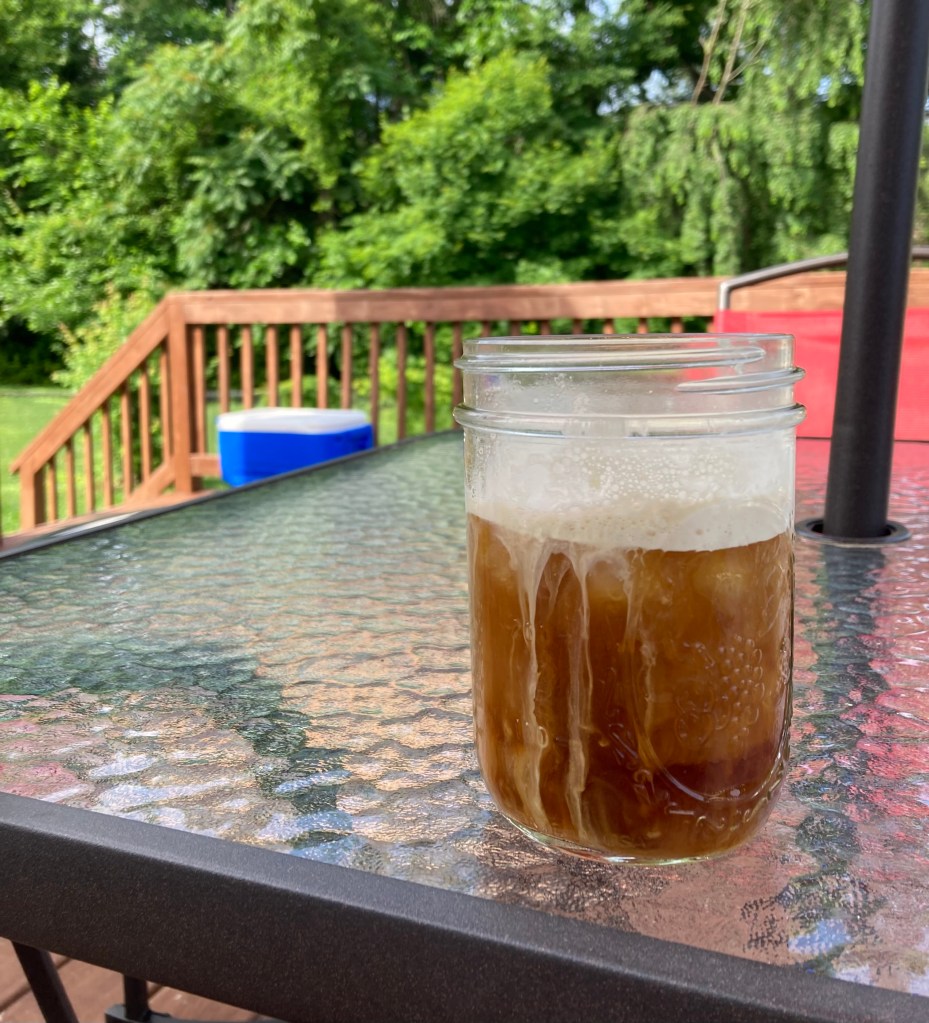
An iced Nespresso Americano with whipped cream on a warm, late spring morning.
Until my mid-twenties, I lived the life of a skinny person. Up to that point I didn’t know most adults must make an effort to maintain a slim physique. Thinness just seemed to happen to me. I ate whatever I pleased and never worked out. In hindsight I can see that I avoided weight gain through a combination of the following – constant anxiety, smoking, walking everywhere because I didn’t know how to drive, being broke most of the time, my metabolism, and prioritizing cigarettes and beer over food. I never dieted. I associated exercise with gym class (a.k.a. torture), so I didn’t bother with that either. I neglected my body, but I never longed to change it in any significant way. I had mild gripes, like how my short-torso-to-long-limb ratio sometimes frustrated me when I shopped for clothes. But I didn’t relate to cultural tropes around young women criticizing their own bodies. I was too caught up in my weird brain to get hung up on any of that.
And then came a major transition phase. Therapy. Getting into healthier relationships. Eating. Taking better care of myself. And also slower metabolism. Suddenly my old clothes weren’t fitting anymore. By age 26 I was no longer skinny. And while that really bothered me at times, I wasn’t about to part ways with food or adopt a rigorous exercise regime to get back to my previous shape. For the most part, I just accepted that my body had changed.
I’ve been through other big bodily adjustments since then, especially as I moved into more and less sedentary lines of work. I started going to the gym in my thirties once I finally figured out exercise was good for my anxiety. Then I went through pregnancy and nursing. Doing natural childbirth made me feel more curious and courageous about my physical strength, so I started attending boot camp classes that made me face my old gym class fears. Eventually I got tired of that and took up jogging instead. And then there was that whole wacky pandemic experience, the ultimate in sedentary lifestyle! Now I’m more physically active again, but also going through perimenopause. I’m not the fattest I’ve ever been, but I’m about 15 pounds heavier than I was five years ago. Between all the lifestyle and hormonal shifts, my body has gone from bigger to smaller to bigger a lot in the last twenty years. The one consistent thread throughout all of it is this – whether I’ve been slender or thick, I’ve more or less accepted my shape at the time and just let it be.
I didn’t know until recently that there’s a term for this state of acceptance — it’s called “body neutrality.” It’s different from popular conceptions around “body positivity,” because I’m not that concerned with being perceived as beautiful by me or anyone else. I don’t look down on people who put a lot of thought or creativity into their appearance, because I know that’s a totally legitimate form of self-expression. It’s just not my priority. I’m generally content with my appearance as it is, because I know it’s one of the less important things about me.
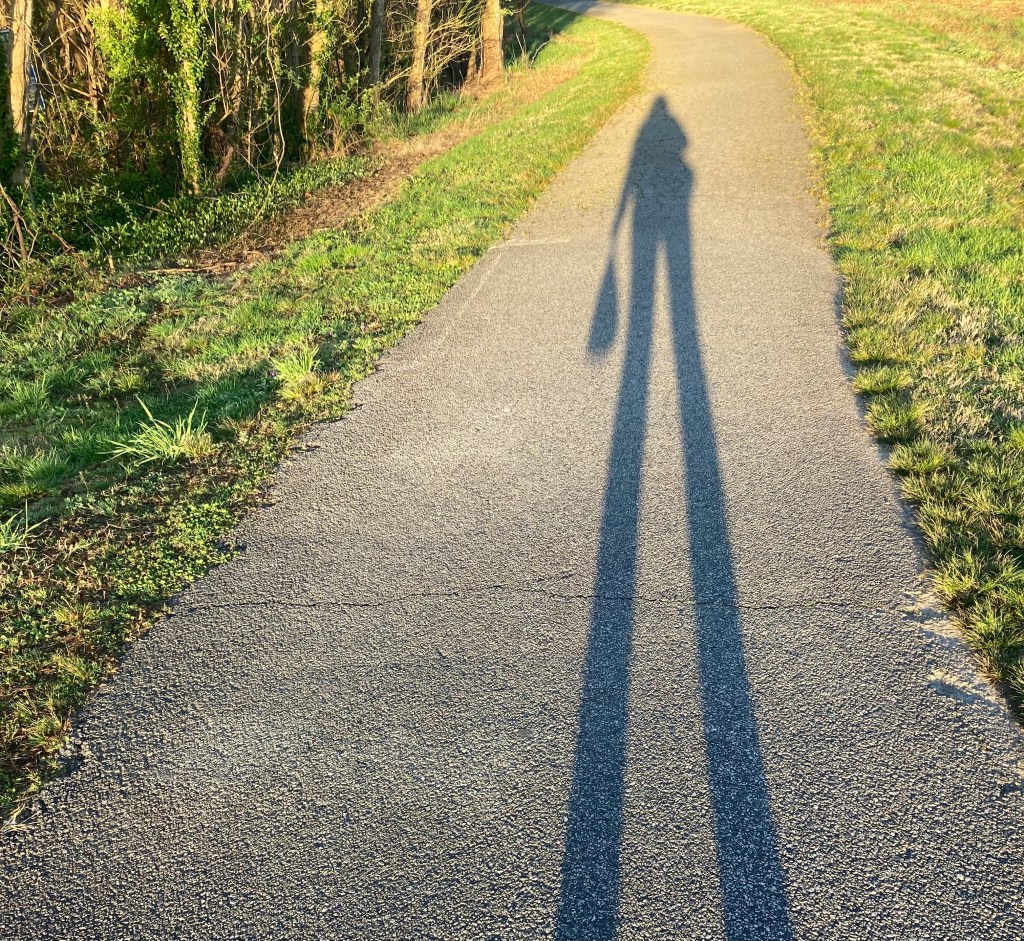
This concept of body neutrality has brought me much peace. I used to think there was something wrong with me for not being more into celebrating my appearance. But now I understand my level of attention to it is just fine. Like it’s okay that I don’t adore everything about my body. Frankly, I’m not wild about the droop of my belly fat or the bumpy feel of cellulite on the back of my thighs. I appreciate my body less for how it looks and more for the experiences it affords me. I’m so grateful to my taste buds for allowing me to relish one of life’s greatest joys. I love my height and how my legs carry me so far, so quickly. I feel powerful when I use my long arms to help others reach stuff that fell behind the couch. And I grin whenever I see the familiar shape of my long shadow in the morning sun, because it looks just like a scaled up version of the one I saw when I was a little kid walking to school.
I admit that feeling attractive to other people does matter to me. Fortunately, I’ve been blessed with a husband who thinks I look hot pretty much 24/7. I certainly don’t get as much attention for my looks from others as I did when I was young and thin. But I also know that attention never made up for my other anxieties and fears. I just like this calmer, more confident, rounder and wrinkled version of me way better! Anyway, I know I look my best when I’m smiling or laughing, which I do a lot. I enjoy my life, even when I don’t feel particularly pretty.
Nevertheless, I do sometimes feel nostalgic for the effortless hotness of my youth. Yet I also recall it getting me icky attention I didn’t want, and I’m not just talking about creepy dudes. Like I don’t miss when my older women coworkers would whine “I wish I had your problems” when I told them I felt too anxious to eat. And I feel sad when I remember insecure boyfriends who would confess in intimate moments that they couldn’t believe someone as slender as me wanted to be with them. Thinness was a currency I never tried to earn, and I have no interest in doing the work it would take to get it back. I love my carbs, my couch, and my peace too much.








 Stuff I Love